Zcash2026-09-18 12:50:01Zcash Eyes Nov. 5 NU7 Upgrade to Cut Block Times to 25 Seconds and Speed Up Private PaymentsZcash developers are aiming for a Nov. 5 launch of the NU7 upgrade, a proposal that would reduce target block times from 75 seconds to 25 seconds and make shielded payments faster to confirm. The plan also introduces a Network Sustainability Mechanism that would temporarily remove roughly 60% of transaction fees from circulation and later return those funds to miners through block rewards starting in February 2031. According to CoinDesk, the proposal keeps Zcash’s issuance and halving schedule largely intact by cutting the reward per block to one-third of its current level and extending the halving interval from 1.68 million blocks to 5.04 million. The upgrade timeline follows discussions among Zcash Foundation, Project Tachyon, Valar, ZODL and Shielded Labs, with the groups reaching unanimous agreement after community and coinholder polling. About 2.4 million ZEC, or 66% of the eligible voting pool, took part. Of those votes, 98.9% supported keeping the current halving schedule, while 96.6% backed February 2031 as the date when collected fees would begin flowing back to miners. A final mainnet decision is due on Oct. 20.400
Market Analys2026-09-10 01:33:12Ignas warns lower trading volume could weaken stock-token and meme coin incentivesDeFi researcher Ignas said in a post on X that the current narrative around stock-linked tokens and meme coins depends heavily on trading volume and fee generation. If volume dries up, the rewards, buybacks and burn mechanisms supporting these tokens could also disappear, reducing the incentive to hold and potentially leading to selling pressure. He pointed to several examples: STONK, PONS and CASHCAT use platform fees for token buybacks or burns; INDEX uses trading fees to buy tokenized stocks; ZCAT funds ZEC rewards through trading taxes; and SHROOM recycles fees generated by the LP network back into liquidity. Ignas also cited Coinbase’s previous cycle as a reference point, noting that its quarterly trading volume fell from $547 billion in the fourth quarter of 2021 to $145 billion one year later, a drop of about 74%. He added that meme coin volume could fall even more sharply once market attention fades. Based on that comparison, he said projecting full-year revenue or yield for these projects using today’s elevated trading volume and fee levels may overstate their sustainability.870
Arbitrum2026-09-06 14:27:23Arbitrum and Solana Co-Founders Clash Over Transaction Costs, MEV ProtectionOn Sept. 6, Arbitrum co-founder Steven Goldfeder and Solana co-founder Toly debated blockchain transaction fees, MEV protection, and single-sequencer models. Steven defended upfront fees against hidden MEV costs, while Toly countered that Arbitrum's spread and fee structure are more costly than sandwich attacks, calling its sequencer model inferior to permissionless competition.990
Bitcoin2026-09-01 00:12:44Christine D. Kim says Bitcoin Core v32 is feature-frozen, with release expected in OctoberBitcoin Core v32 reached feature freeze on Aug. 20, according to Protocol Watch founder Christine D. Kim, with developers now focused on bug fixes and smaller optimizations ahead of a planned release in October this year. The update includes several performance and operational changes inside the software rather than any change to Bitcoin’s network rules. Kim said the release can raise block validation speed by as much as 3x through parallel processing across multiple CPU cores. It also adds a global transaction queue and rate limiting, changes aimed at improving node stability during sudden spikes in transaction activity. Another addition is a fee estimation mechanism based on mempool conditions, which is intended to reduce fee overestimation. She also said the v32 update does not include changes to protocol rules at the Bitcoin network layer. The current development stage centers on fixing bugs and making limited refinements before the formal launch.900
Solana2026-08-31 20:17:39Solana fee revenue climbs as SGP-0002 deflation proposal clears voteSolana’s fee revenue denominated in SOL reached a seven-day average of nearly 9,200 SOL on Aug. 27, up more than 80% from three months earlier, according to ChainCatcher. Non-vote transactions also hit a fresh seven-day high of 191 million, compared with 88 million a year ago, while daily Jito validator tips averaged 2,073 SOL over the past week, up 26% week over week. At the same time, the SGP-0002 “double deflation” proposal passed last Friday with just over 67% support, above the 66.67% threshold. Voter participation reached 60.7% across 1,326 validators, setting a record for on-chain governance participation on Solana. The proposal doubles the annual deflation rate from 15% to 30% and is expected to remove about 18.9 million SOL from planned issuance over six years. That would cut the amount of new SOL entering the market each year and reduce validator income for the same amount of work. Staking rewards are projected to fall from about 5.25% to 2.25% in the third year, putting pressure on validators that rely more on inflation income than transaction fees.910
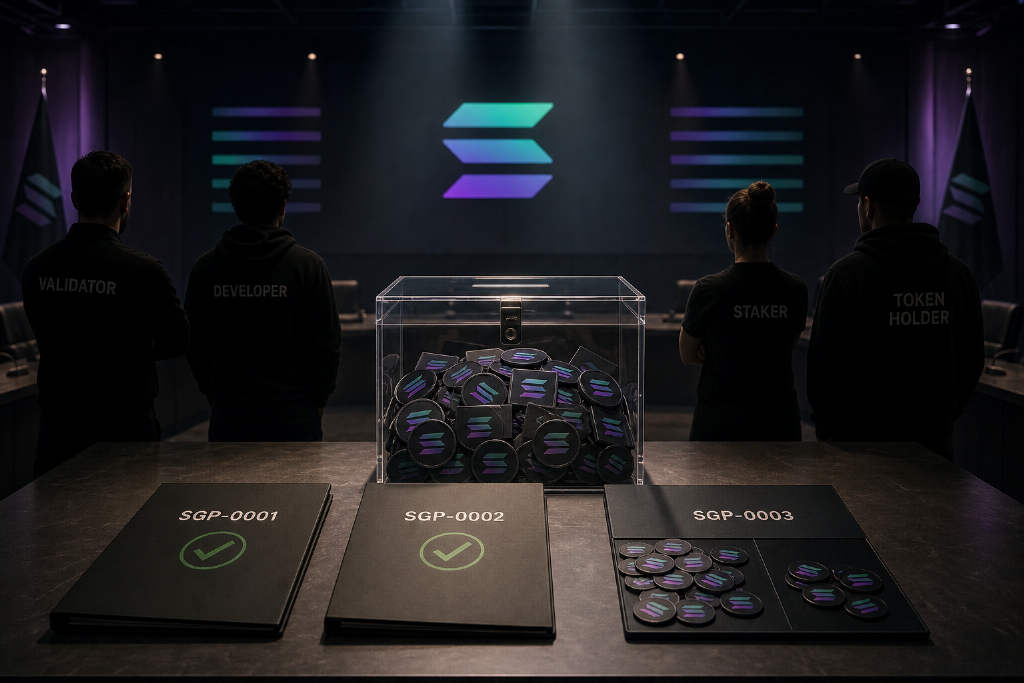
Solana2026-08-28 15:34:08Solana’s first on-chain governance vote ends with SGP-0003 rejected after fee model disputeSolana’s first formal on-chain governance vote has closed, sending SGP-0001 and SGP-0002 into implementation while rejecting the more contentious SGP-0003 proposal. The three proposals, which opened for voting on Aug. 23, covered a formal governance framework, changes to SOL’s inflation schedule, and a redesign of transaction fees. SGP-0001 and SGP-0002 cleared the required thresholds of one-third participation from all valid staked SOL and a two-thirds approval ratio among votes cast. SGP-0003, which would have overhauled how the network prices blockspace, received 54.3% support, below the 66.6% bar. The split exposed competing priorities inside the Solana ecosystem. Supporters said charging more for resource-heavy transactions would better align costs with network usage and could sharply increase SOL burned through fees. Critics, including application developers, argued the proposal would raise costs for complex on-chain activity and make core business assumptions subject to governance risk. The vote leaves Solana with a new governance process and a faster path to lower inflation, but without consensus on how its growing financial infrastructure should price network resources.450
Solana2026-08-28 15:27:20Solana's "Double Deflation" Proposal Passes Two-Thirds Vote ThresholdSolana's "double deflation" governance proposal has passed its voting phase with 67% approval, clearing the two-thirds support threshold required for adoption. Official figures show 60.69% of voters participated, while 25.16% voted against and 7.84% abstained. The plan would lower SOL's inflation rate to approximately half of current levels, raising the deflation rate to 30%. According to current estimates, this could remove roughly 18.9 million SOL from token issuance over the next six years. In a separate vote, the "resource and inclusion fees" proposal failed to reach the two-thirds requirement, drawing 53.9% support against 18.92% opposition, with 27.18% abstaining and 61.14% participation. That proposal sought to introduce a resource-based transaction fee mechanism, charging according to how much network capacity each transaction consumes. If implemented, it was expected to raise SOL's daily burn rate from roughly 650 tokens to between 7,500 and 9,000. Both voting results were posted on the official webpage, per BlockBeats.870
Solana2026-08-28 15:28:08Solana double-deflation proposal clears voting threshold as ballot phase endsSolana’s voting phase for a double-deflation proposal has ended, according to the project’s official webpage. The measure recorded a 60.69% participation rate, with 67% of votes cast in favor, 25.16% against, and 7.84% abstaining. That placed support at the two-thirds threshold required for passage. The proposal would cut SOL inflation to roughly half its current level, lifting the deflation rate to 30%. Based on current estimates, it would reduce SOL issuance by about 18.9 million tokens over the next six years. A separate proposal covering resource and inclusion fees also completed voting. That measure posted a 61.14% participation rate, with 53.9% in favor, 18.92% against, and 27.18% abstaining. Its support level did not meet the two-thirds requirement. That second proposal called for a transaction fee mechanism based on resource consumption, charging fees according to the network resources used by each transaction. It was expected to raise daily SOL burn from about 650 tokens to roughly 7,500 to 9,000 tokens.920